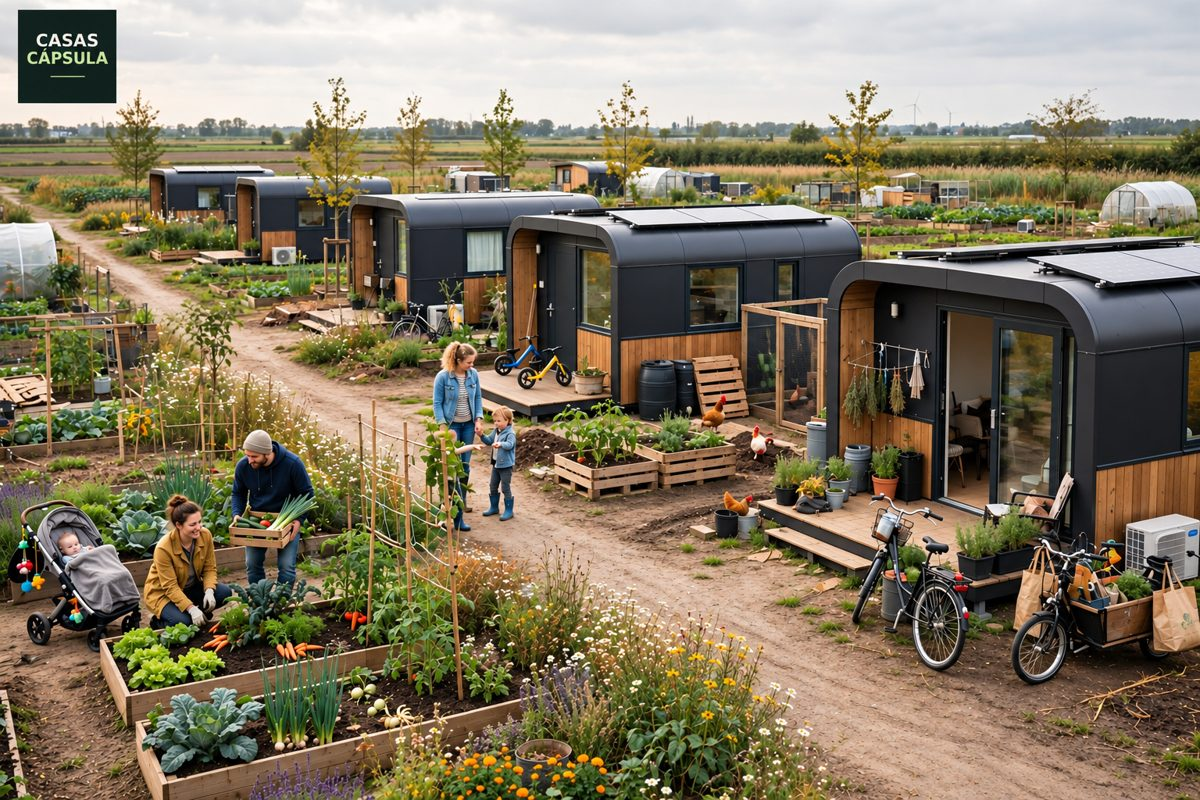
The future of housing depends on more than how a home is manufactured. It also depends on who organises land, roads, water and shared spaces. Oosterwold, in Almere, the Netherlands, is a real urban development where residents participate in those decisions.
The actual project behind the idea
The official website describes participants developing homes while contributing to their neighbourhood and landscape. Urban agriculture, water and community life form part of the approach. For readers considering compact housing, its relevance is the connection between a dwelling and its wider setting.
Oosterwold is relevant because of how development is organised: every home belongs to a landscape and a set of shared responsibilities. For CasasCápsula it is a useful reference when studying small neighbourhoods, cooperatives and housing projects with communal spaces.
Design freedom comes with responsibilities
Selecting a home is one part of the project. Before comparing suppliers, establish individual and shared responsibilities for the plot, access, water, maintenance and coordination. Our interpretation is that a collective approach is valuable because these decisions can be considered together.
Municipal rules matter as much as architecture. The reviewed council page describes a more detailed process for applications from 1 February 2026 and distinguishes contractual obligations from planning rules. The approach should not be reduced to placing modules without permissions.
What a project in Spain could learn
A developer, cooperative or municipality can use Oosterwold to frame questions: what community is intended, how should land be organised, who operates infrastructure, and how is the entire development financed? Those questions need professional assessment under the conditions of the selected Spanish municipality.
A prefabricated home could form part of such a proposal if it meets the design and requirements. Oosterwold does not show that every capsule is permissible or provide a price transferable to Spain. The broader lesson is that compact housing needs a neighbourhood plan and an organisation that makes it work.
From inspiration to a defined project
Prepare a brief covering location, intended use, planned household numbers, land status and outstanding questions. This helps compare requirements before collecting isolated module quotations. Start with our guides to land and location, complete costs and compact housing and cities.
Does your company want to contribute a documented case or propose sponsorship? Explore collaboration options. Sponsorship is identified separately from editorial content.
Sources
- Maak Oosterwold: official project description.
- Almere council: agreements and procedure, including applications from 1 February 2026.
Reviewed 11 October 2026. Original editorial analysis. Independent editorial content.