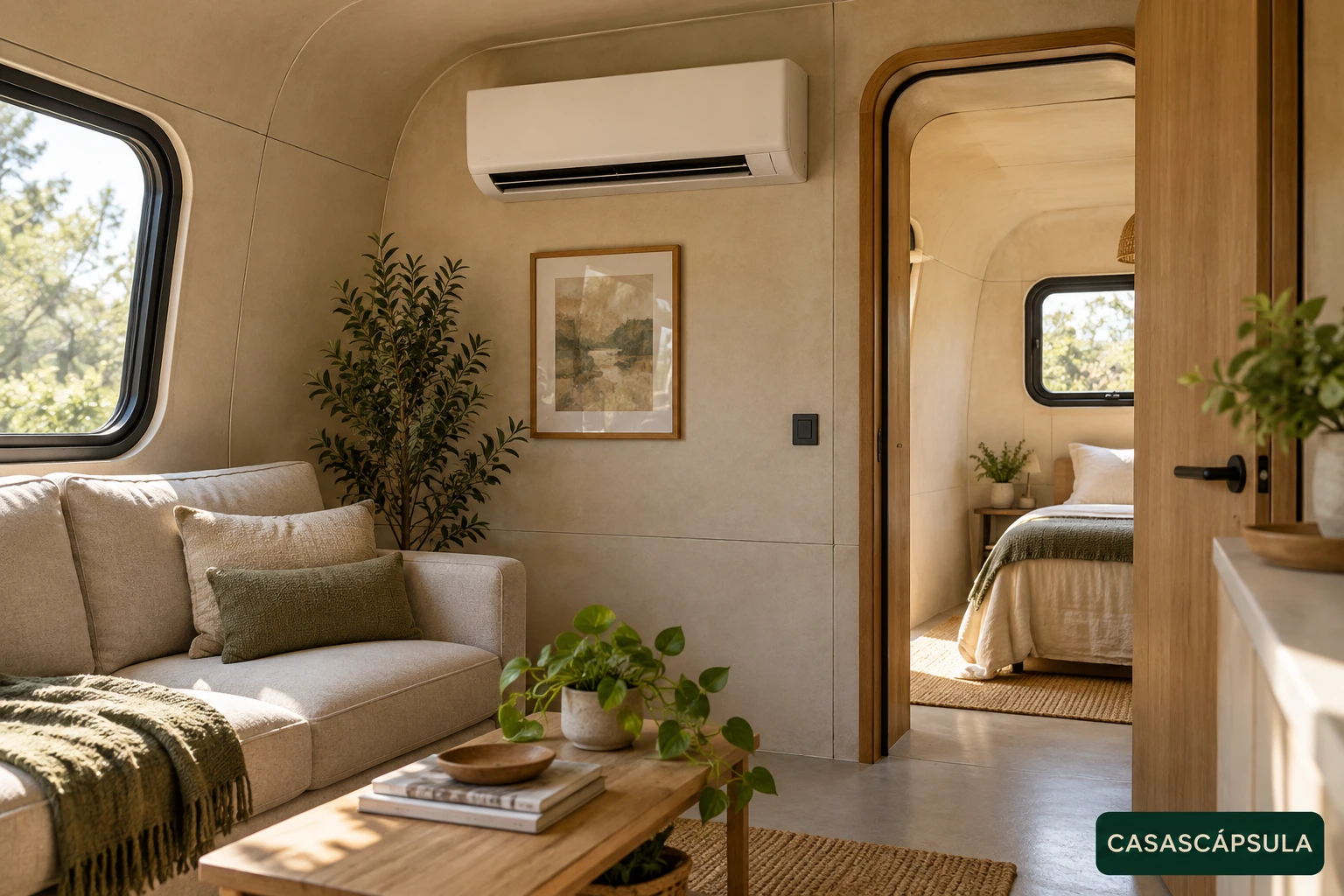
Original CasasCápsula conceptual illustration; not a commercial model or a real installation.
“Air conditioning included” can look like a solved item when buying a capsule home. Yet the important questions may remain unanswered: which equipment will arrive, how heating will work in winter and whether the bedroom will stay comfortable with its door closed. This guide turns that quotation line into checks you can discuss.
It does not prescribe one equipment capacity for every capsule. It helps you compare the appliance and its installation before ordering, particularly when planning to live in the home all year.
Start with the model reference, not the word inverter
Ask for the brand and exact indoor and outdoor unit references when the equipment is a combined system. Keep the product information with the quotation version. If substitutions are allowed, ask how they are recorded and approved: “equivalent” needs agreed criteria.
This is our editorial method for comparing offers, not an allegation about a supplier. It gives you and the installer a common reference when discussing electrical supply, placement, maintenance and performance.
SEER and SCOP answer different questions
The European Commission describes SEER as seasonal cooling efficiency and SCOP as seasonal heating efficiency. Its label guidance also separates design load, declared annual consumption and sound power. These fields help compare equipment; they do not establish the performance of a complete home.
| Item to review | Buyer question |
|---|---|
| Cooling | Which information supports the offered summer performance? |
| Heating | Which climate conditions correspond to the supplied figures? |
| Sound | Does the figure refer to the indoor or outdoor unit? |
| Model | Does the product sheet match the order reference? |
An appliance label is not the home’s electricity bill
Do not transfer an annual catalogue figure directly into your household budget. For the project, ask which climate, indoor temperatures and use assumptions are being considered. Buyers with different routines and sites are not necessarily making the same comparison.
EPREL, the Commission’s public database, provides model information for products covered by energy labelling. Where applicable, request a reference that identifies the equipment. Finding an appliance there does not establish planning permission or the performance of the complete capsule.
Ask the question with the bedroom door closed
As a practical exercise, mark the sleeping space and indoor unit on the layout. Ask how heating or cooling reaches that space with its door closed. Do not infer the answer from the total floor area or a living-room photograph.
Also discuss airflow routes, controls and access for cleaning or servicing. A visit with the installation running may reveal useful questions, but it does not replace professional sizing.
Buy the installation as well as the equipment
Create a responsibility line for each task: outdoor support, penetrations through the envelope, connections, condensate drainage and final checks. Ask what the factory completes and what the destination installer finishes. Record exclusions and who resolves tasks falling between the two contracts.
When comparing two offers, read that list alongside the equipment references. One may cover complete installation while the other covers supply only. They may look alike in photographs but represent different commissions. The suitable choice is the one your project team can substantiate for the site and intended use.
Continue planning your purchase
What is still unclear in your quotation? Tell us the project location and your question.
Sources and review date
Primary sources opened and read on 23 October 2026. Tables, examples and questions are original editorial work. No sponsorship or affiliate links. This article does not replace review by the project professionals or competent authority.