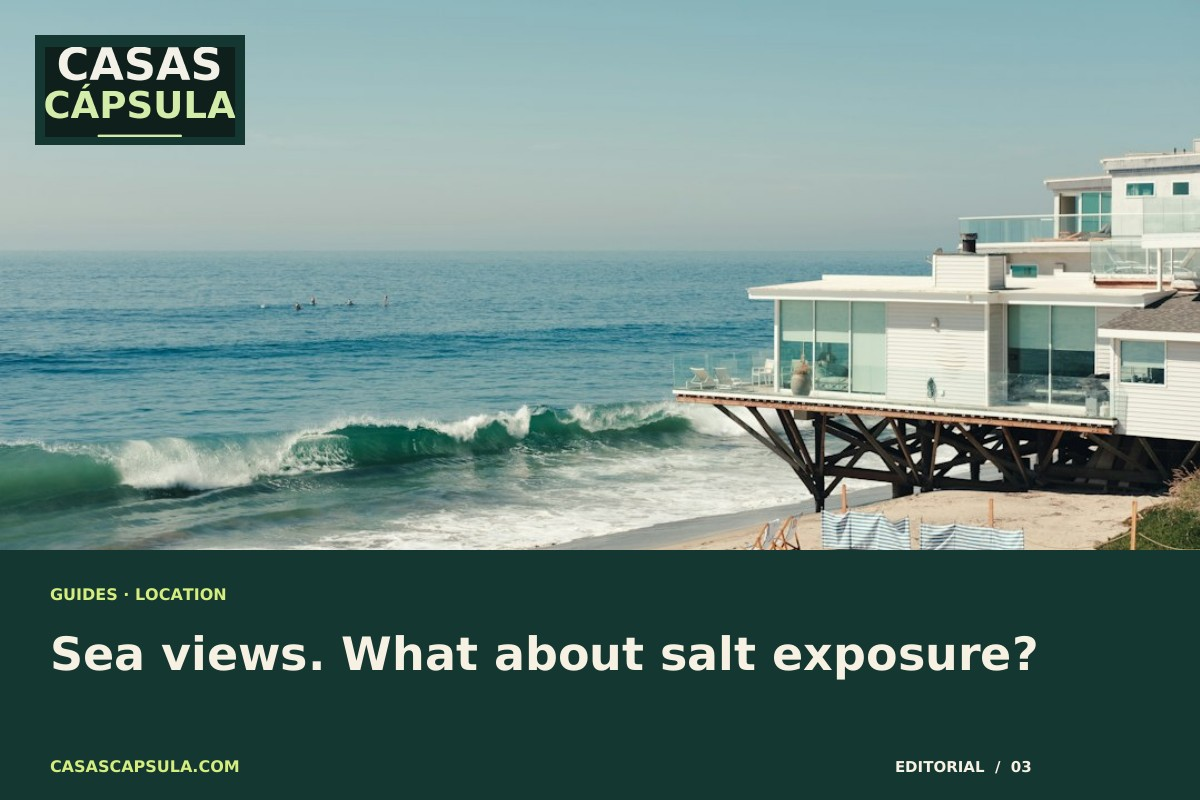
A compact home by the sea is an appealing idea. To make it work, bring the actual location into the manufacturer’s discussion from the first quotation. Changing the background of a rendering does not adapt a home to coastal conditions.
Describe the site precisely
Give the technical team the plot location and describe exposure to wind, proximity to the shore and shelter from surrounding buildings. Let the project team assess the exposure; a universal distance-from-the-sea rule is not a complete specification.
Look beyond the façade
Ask about materials and protection for the structure, fasteners, hinges, anchors and outdoor equipment. Spain’s CTE DB-SE-A discusses steel corrosion prevention in relation to the building, exposure and construction details, including provision for inspection and maintenance where relevant. One component described as stainless or galvanised does not answer the question for the entire home.
Discuss joints and surfaces that will become inaccessible after assembly. Request cleaning and inspection instructions compatible with the finishes, and ask what happens if a protective treatment is affected during installation.
Compare the initial specification and ongoing care
Identify the coastal solution in the quotation, its upkeep requirements and the party handling defects. Obtain warranty exclusions and maintenance obligations before signing. Do not assume every version of a model has the same protection.
The suitability of the location must still be assessed through the relevant planning and coastal framework. An appropriate façade does not replace that assessment. Check access to equipment so future maintenance is practical.
The aim is to enjoy the coast with a home designed for its conditions. Compare quotations for the same exposure and scope, then keep the care plan with the handover documents.
Continue exploring
Sources
Sources reviewed on 11 October 2026.