An emergency bed and a private living space offer different experiences. Help Bristol’s Homeless illustrates how small accommodations can form part of a practical response for people sleeping rough.
A dated, documented expansion
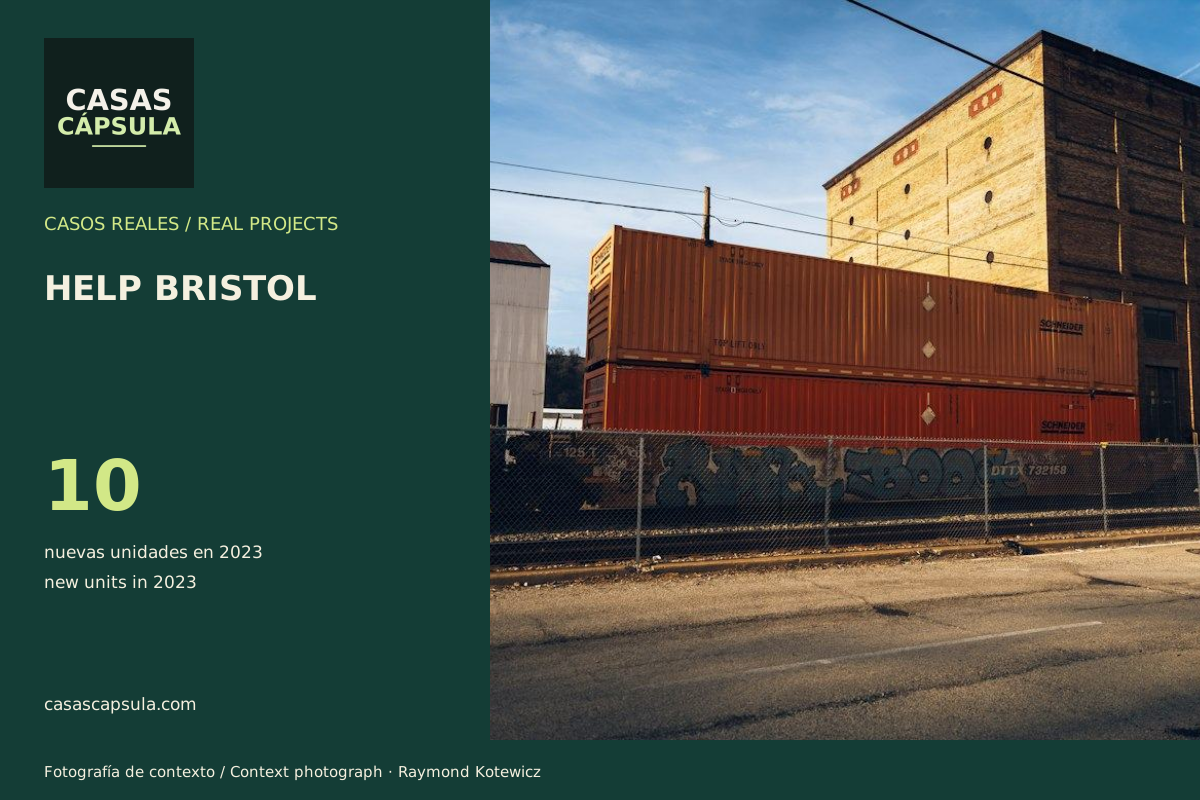
On 11 May 2023, the charity announced ten additional micro-flats, delivered on 4 and 5 May. It described units with a kitchenette, shower room and bedroom. This is the size of that expansion, not the current total inventory.
The Bristol project uses converted containers. It should not be presented as a development of freestanding panoramic capsule homes. It is relevant to compact accommodation, adapted modules and social uses.
Independence is also a design question
Our interpretation is that a private layout can support routines such as preparing food, resting and organising possessions. That is not, by itself, evidence of a clinical improvement or a permanent housing outcome.
We therefore do not attach recovery rates, cortisol reductions or public-cost savings without an identifiable evaluation.
Questions for a comparable initiative
An interested organisation should compare privacy, accessibility, ventilation, upkeep and operating costs. It should also define support arrangements, allocation rules and options when a resident's stay ends.
Phased expansion can be a useful management approach: observe a first group of units before deciding whether to add more. The scale should match people and available services rather than the amount of space on a site.
The documented result
Ten additional units were delivered. That provides a concrete starting point for examining what compact accommodation can do, while leaving social-outcome measurement as a separate question.
Explore related guides
Sources and review date
Reviewed on 11 October 2026. Figures are attributed to project promoters or operators; interpretation is our editorial analysis. Unsponsored editorial content.
Another real-world case
Capsule houses are already bookable rooms: the Khao Kho example