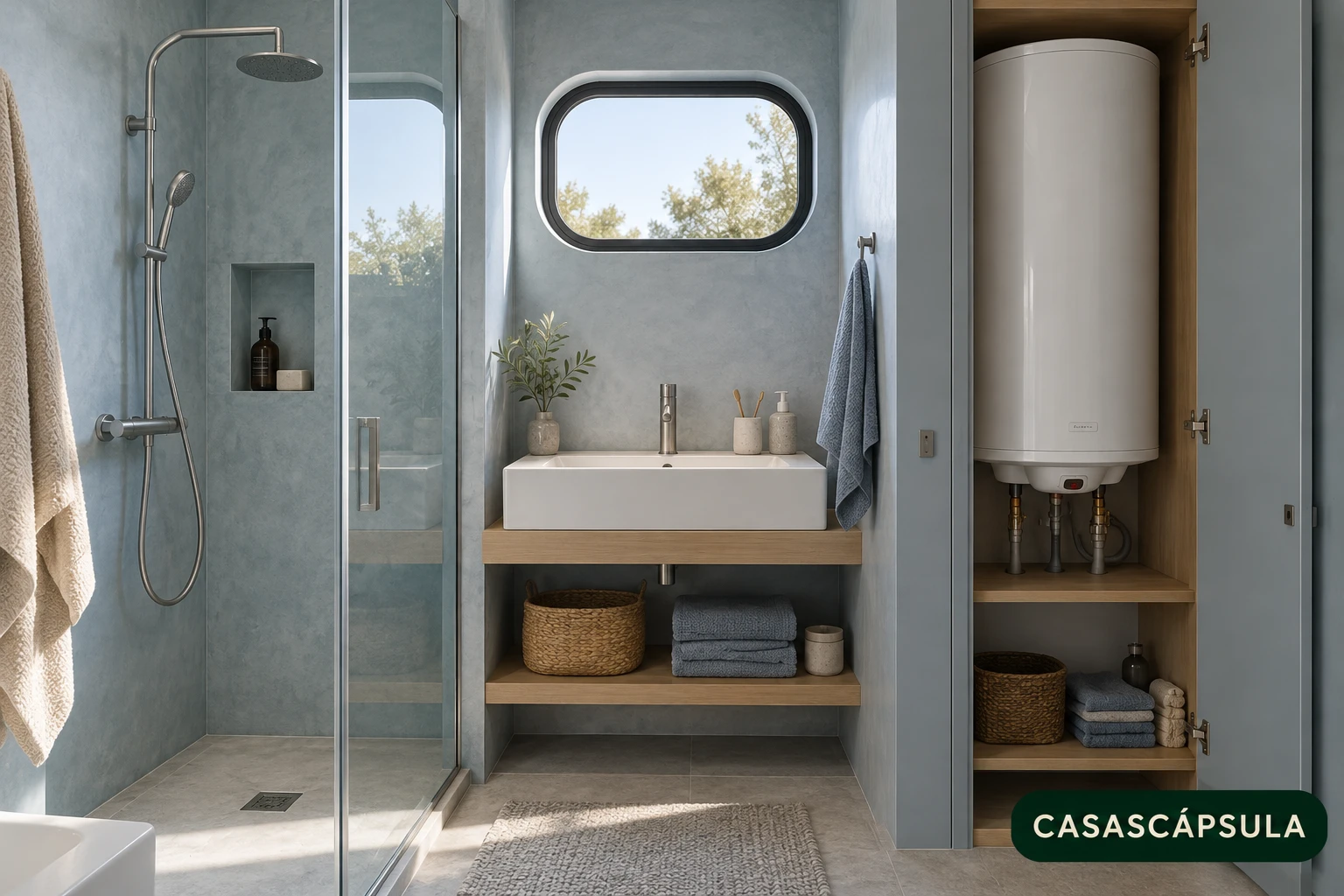
Original CasasCápsula conceptual illustration; not a commercial model or a real installation.
A capsule-home bathroom can have a striking shower and leave an everyday question unanswered: will the second person have hot water? The answer is not in the size of the shower tray. Check how hot water is produced, which equipment the order includes and what happens between uses.
This guide concerns hot-water service. Our connection guide covers incoming water and wastewater; here the aim is to compare offers against an ordinary morning in the home.
“Water heater included” does not yet identify the service
Request the brand, model reference and product information. Ask whether the proposal uses storage, instantaneous production or another solution, and where the equipment is installed. Do not turn a capacity mentioned in a sales message into a guarantee of consecutive showers.
A useful enquiry describes people and routines: two people showering one after the other before leaving need to consider a different scenario from showers spaced far apart. Add overlapping uses such as washing up. This is our proposed comparison exercise, not a regulatory demand or an installation calculation.
What the label contributes, and what needs a separate question
The European Commission includes load profile, energy class and consumption in its explanation of water-heater labelling. A load profile helps identify the product’s evaluation conditions; it should not by itself become “suitable for this household”.
Where the equipment is subject to that labelling in the European market, request identifiable product information. Our buying method is to examine the offered model and intended service together rather than choosing on the efficiency letter alone.
A table for discussing your routine
| Your scenario | Answer we would request |
|---|---|
| First shower | Starting conditions and the service proposed for checking |
| Immediate second shower | How the supplier explains continuity of service |
| Waiting between uses | Recovery information and the conditions behind it |
| Kitchen used simultaneously | Which assumptions are used to assess both uses |
| Extended absence | Shutdown and recommissioning instructions |
Use this table to obtain a written explanation, not to set temperatures or adjust equipment yourself. Operating and maintenance questions belong with the manual and responsible professional.
If you can visit a unit, establish whether it is comparable
Ask whether the display home’s equipment matches your quotation. Request an agreed, supervised demonstration of the scenario you want to understand, recording what was checked and under which conditions. A demonstration with another configuration does not automatically document the one you will receive.
If no unit can be visited yet, request information and an explanation from the equipment supplier. Keep unanswered questions visible. An acknowledged gap is more useful than turning a visual impression into a promised performance.
Leave room for maintenance
Locate service access on the plan and ask what must be removed for an intervention. Establish who can service the equipment at the destination and what commissioning the quotation includes. Fitting a heater into a cupboard is not enough if nobody explains replacement access.
A sound comparison ends with a specific answer: what equipment is delivered, which use has been considered and who installs and checks it. We do not prescribe a universal tank size or promise a bill. The aim is for the attractive shower to fit everyday life too.
Continue planning your purchase
- Capsule-home water and wastewater connections
- Living in a capsule home all year
- Maintenance and after-sales
What is still unclear in your quotation? Tell us the project location and your question.
Sources and review date
Primary sources opened and read on 23 October 2026. Tables, examples and questions are original editorial work. No sponsorship or affiliate links. This article does not replace review by the project professionals or competent authority.