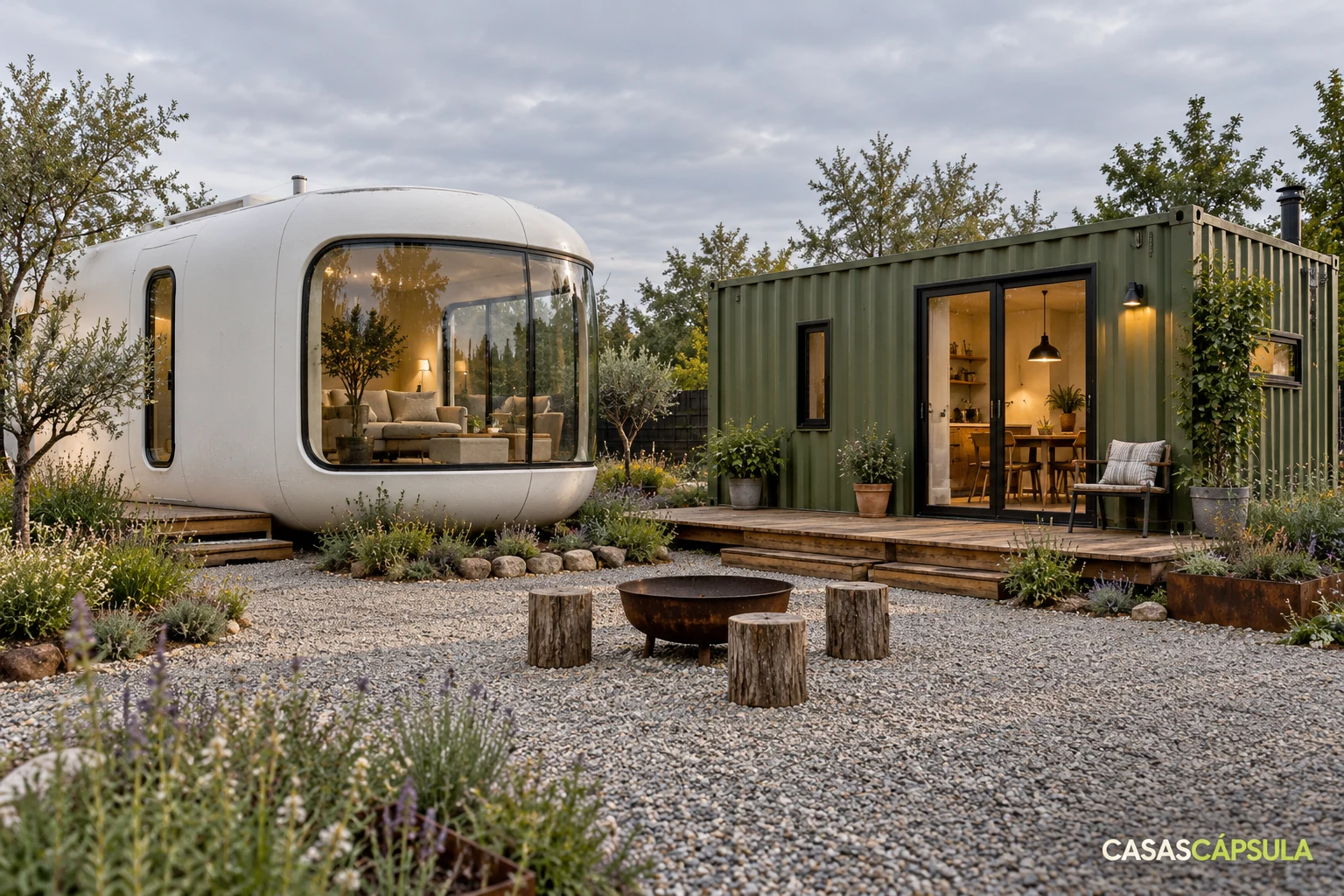
Original AI-generated editorial illustration; not an identified manufacturer’s model or an actual factory visit.
A panoramic capsule home and a home made from a shipping container can both offer an appealing way to live in a small space. Both may arrive by road and look like neighbouring alternatives in a prefab search. Choosing well means separating appearance, structural origin and what each quotation supplies.
The question is not which always wins. It is which solution fits your layout, site and complete budget. This comparison concerns capsules and converted maritime containers; it does not replace our broader tiny-house or panelised-construction guides.
First, which kind of container is being discussed?
“Container house” can appear in advertising for different products. Before comparing, ask whether the unit is made by converting a shipping container or is a newly built rectangular module. Request a contractual description resolving that distinction rather than inferring it from corrugated cladding.
Arqtainer provides a useful public example: it presents one range based on maritime containers and another using SIP panels. The company itself distinguishes systems within its offer. That does not establish identical terminology across other suppliers.
A capsule is not one universal technical specification
Volferda separates product families such as Capsule House, Apple Cabin and Expandable Container House. Those are that supplier’s categories, not a standard certifying every home with a similar shape.
For purchasing, request the structure, envelope and precise configuration. Curved styling may be a design preference; it does not by itself explain what lies behind the finish or how much of the interior volume you can use.
Compare the room you will actually use
Put your bed, bathroom route and workspace on both plans. Request finished internal measurements, not only external width. Use the same accommodation brief across configurations so one does not appear better merely because it contains less furniture or a smaller bathroom.
| Decision | Question for both suppliers |
|---|---|
| Origin | Converted shipping container or frame manufactured for this module? |
| Space | What finished internal dimensions and heights does this version provide? |
| Openings | Which documents describe windows, doors and alterations? |
| Delivery | What arrives and what remains to be completed on site? |
| Project | Who assesses suitability for the site and intended use? |
If a container is used, ask about that actual unit
Request identification, condition and conversion information alongside the home drawings. The aim is not to assume a container is problematic; it is to establish what was used and which documents accompany the result.
Apply the equivalent exercise to a newly manufactured capsule: identify the model and accepted variations. “New” does not automatically guarantee execution, and “reused” is not a universal disadvantage. Compare evidence relevant to what will be supplied.
Which costs less?
This comparison cannot establish a price winner. Ask both candidates for a quotation for the same plot, identifying transport, unloading, supports, connections and completion. Separating included and outstanding work reveals why similar prices may cover different commissions.
If you only have a catalogue figure, use it to begin the enquiry rather than close the budget. Also establish the layout changes each proposal supports before assuming later modification is straightforward.
The choice can begin with what you like
If a capsule appeals to you, start there; if you prefer the container’s industrial appearance, explore it. Then compare two complete proposals for the same project. A good decision keeps the home you are excited about while adding the answers needed to buy thoughtfully.
Continue choosing your home
- Capsule, tiny house and modular home
- Panelised or volumetric: what reaches the site
- The complete budget
What are you comparing? Tell us the country, intended use and question about your project.
Sources and scope
Primary sources opened and read on 24/10/2026. Supplier examples are attributed to their websites; questions, tables and exercises are original editorial work. No sponsorship or affiliation. We have not audited factories or verified model performance.