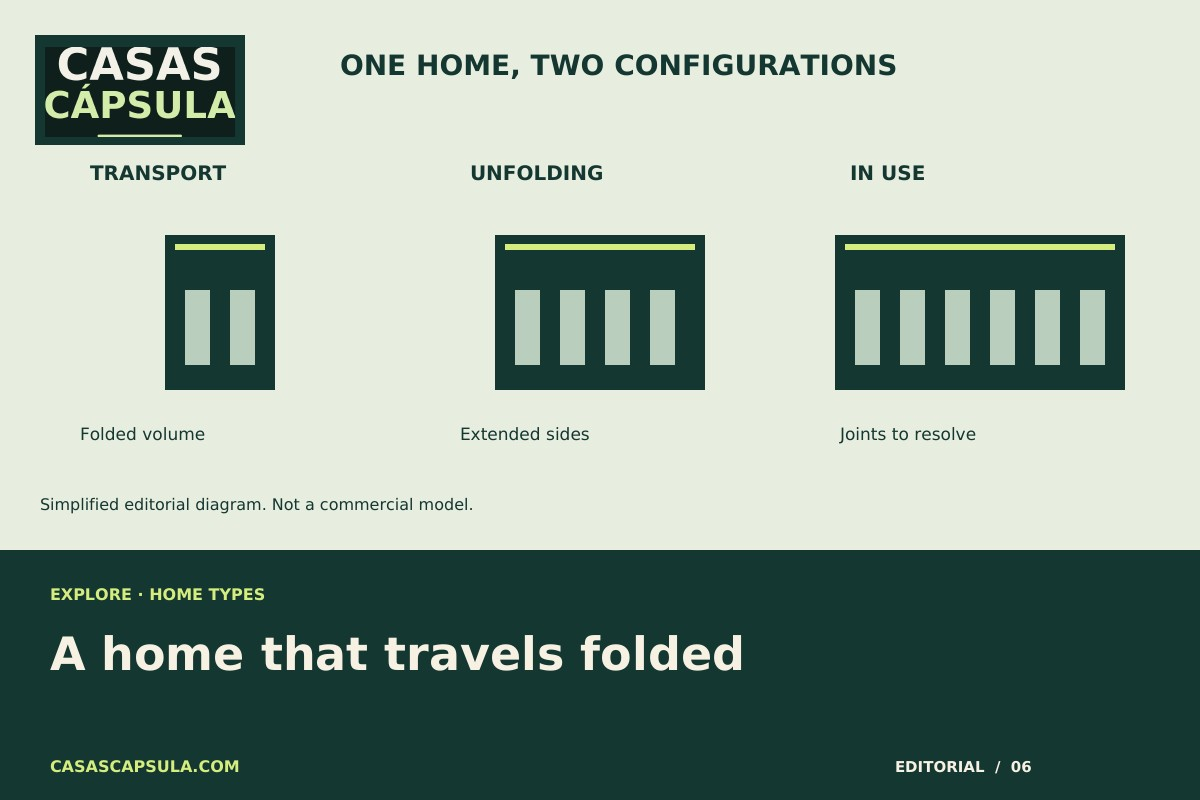
Some videos show a narrow delivered unit unfolding sideways to create more space. These systems deserve a place alongside fixed-volume panoramic capsule homes, but they are not the same product family. Travel configuration and usable configuration can differ.
Folding and expanding describe different arrangements
Chinese manufacturer K-HOME lists folding and expandable ranges on its own website. That is a primary source for their existence, not independent validation of every advertised claim. Identify which elements move: walls, floor, roof or side volumes.
A rigid capsule may arrive at its final volume. An expandable system adds an opening operation and particular connections, changing the questions a buyer needs to ask.
Compare transport and use
Request drawings of both configurations, dimensions, weight and usable area after installation. List components and work remaining after opening. Deploying the mechanism does not establish that the kitchen, bathroom and all connections are ready.
Ask how moving junctions are sealed and how floor continuity, insulation and services are arranged at those points. Request inspection, seal-repair and access instructions. If future folding is intended, obtain its conditions and limits; initial folded delivery does not prove that repeated folding is an ordinary residential operation.
Compare installed scope
The quotation should identify people and equipment for deployment, levelling, fixing and completion. The support system needs to suit the actual project; a generic catalogue instruction does not replace a site assessment. Planning and habitability remain separate checks.
The potential benefit lies in logistics and a system that fit your project. Compare a documented, deployed unit with a rigid capsule of equivalent performance and scope, rather than comparing the speed of two videos.
Continue exploring
- Capsule house, tiny house or modular home: what is the difference?
- Buying a capsule home in China for installation in Europe: seven checks before you pay
Sources
Sources reviewed on 11 October 2026.