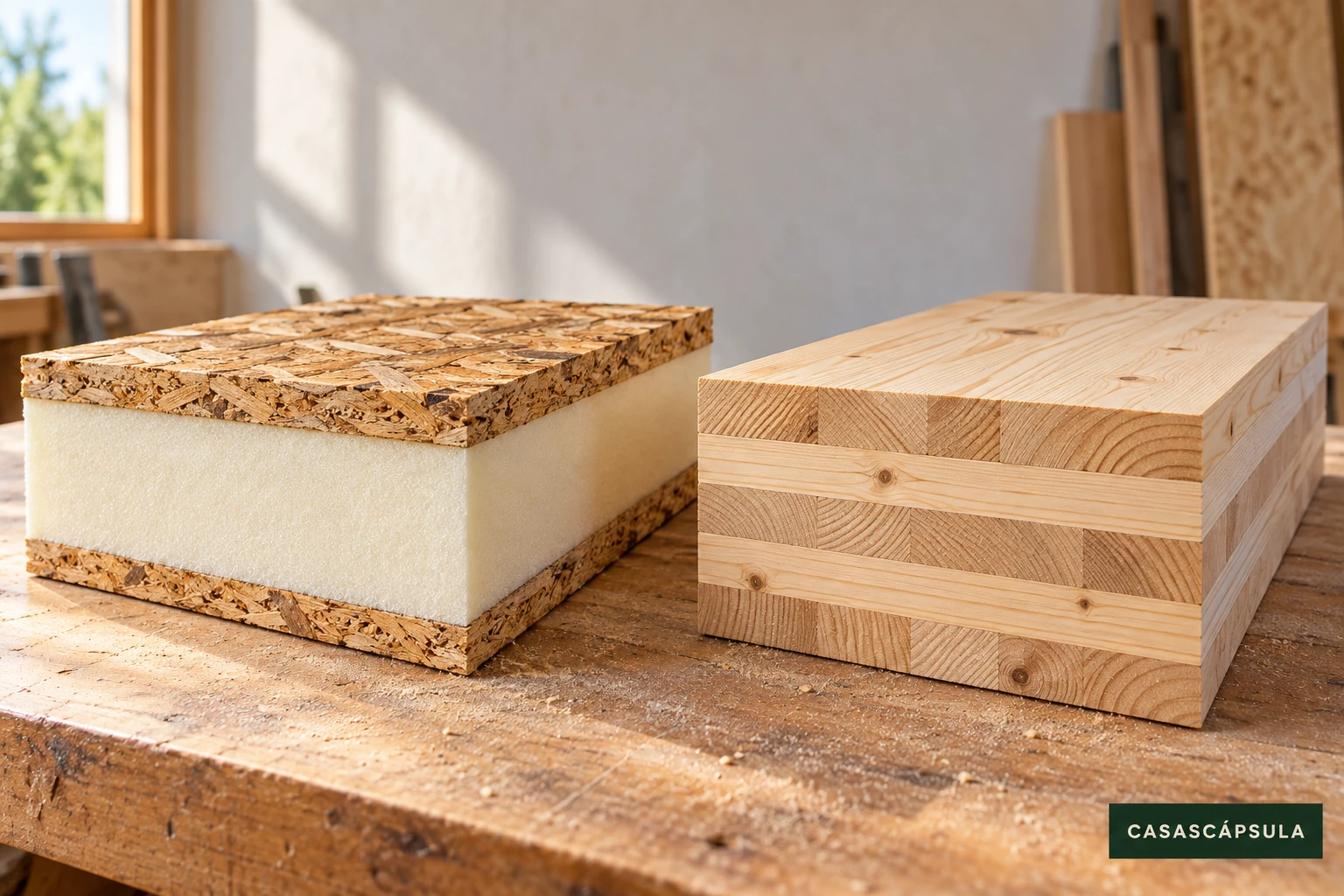
Original CasasCápsula conceptual illustration; not a specific model or shipment.
A timber prefab home can be offered with SIP or CLT panels and finish with a similar-looking facade. The abbreviations describe different products. Ask what forms the structure, how the envelope is completed and which work the proposal includes.
The aim is not to declare one system a winner. It is to avoid comparing a panel supply package with a completed home as though they were the same purchase. A timber structure need not mean exposed timber cladding: the finish is defined in the project.
SIP: a composite panel with an insulating core
The Structural Insulated Panel Association and Structural Timber Association describe SIPs as panels with an insulating foam core between structural faces, typically OSB. Manufacturing combines these layers into a product. To understand a specific offer, request its composition, panel documents and construction-system details.
Do not assume that every product called a “sandwich panel” is equivalent. Ask which function the offered element is intended to perform, how it connects to the rest and which documents support that solution. This guide assigns no fire resistance, structural capacity or thermal performance to a panel merely from its family name.
CLT: timber layers forming a structural element
The Structural Timber Association describes CLT as a structural panel with crosswise timber layers, used for walls, floors and roofs. Manufacturer KLH illustrates that construction and explains project-specific cutting based on production drawings. This describes that supplier’s process, not every commercial CLT offer.
When comparing completed walls, ask for the other layers forming the assembly: insulation, protective layers, finishes and interfaces according to the project. Structural-panel thickness alone does not explain the performance of the entire facade.
Four distinctions that should appear in the quotation
| Question | Useful check for both alternatives |
|---|---|
| What product arrives? | Composition, drawings, identification and supply scope |
| Which part of the home does it resolve? | Separate structure, insulation, finishes and remaining work |
| Who completes interfaces? | Responsibilities for joints, openings, services and seals |
| What is substantiated? | Product documents and project-specific assembly verification |
This table is an editorial enquiry aid, not a substitute for professional calculation or assessment. If an interface detail is not yet available, record it as pending rather than assuming both options will resolve it identically.
Buying panels is not buying a ready-to-use home
Identify design, transport, unloading, assembly, protection during construction, roof, facade and services. Mark which items are completed, which are supplied for assembly and which require another contract. One company may offer several supply levels; its general catalogue does not define yours.
Before comparing timelines, identify their milestone: manufactured panels, assembled structure, enclosed envelope or a commissioned home. A panel-based system and a volumetric unit require different organisation. The SIP/CLT distinction alone does not answer that separate question.
How to request genuinely comparable proposals
Give both companies the same housing programme and site. Ask them to identify the performance the project proposes to substantiate and the included work needed to achieve it. Keep changes in thickness, floor area and finishes visible in the drawings.
We recommend no generic saving percentage, universal lifespan or whole-home certification based on the panel choice. A useful decision connects the product to the complete solution, the team delivering it and the records you can retain. For a home on your plot, those answers matter more than an abbreviation.
Continue comparing
- Panels and modules: what arrives on site
- Timber companies and systems in Spain
- Design and technical responsibilities
Considering a purchase or development? Tell us the country, intended use and question you still need answered. These questions help us prepare useful information; submitting one does not imply a quotation or supplier representation.
Sources and scope
- Structural Timber Association: SIPs
- Structural Timber Association: mass timber y CLT
- Structural Insulated Panel Association: qué son los SIP
- KLH: producto de madera contralaminada y proceso de suministro
Primary sources reviewed on 23 October 2026. Comparison lists and examples are CasasCápsula editorial work. Commercial statements are attributed to their supplier. This article contains no sponsorship or affiliate links.