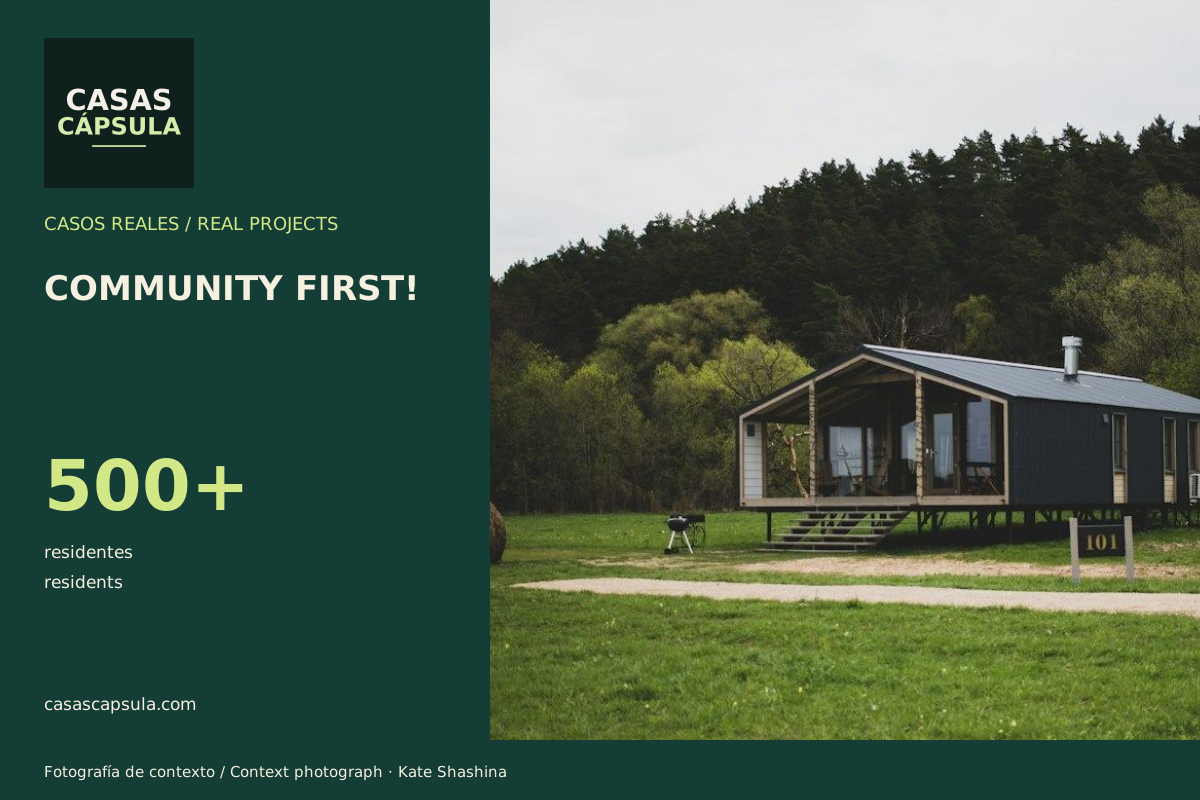
A small home can change a life. Community First! Village in Austin shows how compact accommodation can become part of a neighbourhood response to chronic homelessness. Mobile Loaves & Fishes combines housing with an organised community.
What the published figures show
The organisation reports more than 500 residents as of June 2026. It also reports an average retention rate of approximately 85%, updated in February 2023. These figures describe different reporting dates; the retention figure is not a 2026 annual result. Residents first moved in during December 2015.
The problem it addresses
A place to sleep can be the foundation for a daily routine. Rest, secure belongings and contact with neighbours matter beyond the purchase price of a building.
This is a compact-housing case, rather than a neighbourhood of panoramic capsule homes from a product catalogue. Its relevance lies in linking accommodation to a residential community.
Our analysis: the home belongs to a wider system
A comparable project needs four separate decisions: land and services; homes suited to residents; sustainable funding; and day-to-day organisation. A smaller floor area does not remove those requirements.
A pilot could track housing retention, resident satisfaction, cost per resident and access to services. Those measures would produce evidence for that pilot, rather than assume Austin's published percentage transfers elsewhere.
Before trying to replicate the approach
Unit numbers establish scale, not a complete assessment of wellbeing. Admission arrangements, support and shared-space management deserve as much attention as the housing design. These are the elements a photograph of a small home cannot explain.
Shared spaces and work: two parts of the model
Mobile Loaves & Fishes describes clusters of 40–50 homes around shared areas. Its website also reports approximately $1 million in dignified income earned by neighbours in 2025 through Community Works and other micro-enterprises. This is a work-programme result, not a return on the homes or a healthcare saving.
A comparable project should plan accommodation, communal spaces and everyday organisation together. Smaller units do not replace support or neighbourhood management.
Source: Mobile Loaves & Fishes, reviewed 11 October 2026.
Another approach to housing and community: Oosterwold →
Explore related guides
Sources and review date
Reviewed on 11 October 2026. Figures are attributed to project promoters or operators; interpretation is our editorial analysis. Unsponsored editorial content.
Another real-world case
42 accommodations in 26 weeks: Barcelona’s modular housing example